

Call us: 07749674445

Most professionally cleaned carpets are surface-dry within 6–12 hours and fully dry inside 24 hours. The single biggest lever you have is airflow: switch on your HVAC fan and point a couple of box fans across the pile the moment the cleaner leaves. Do that, and you’ll often shave hours off the wait. Leave it damp past 48 hours and you’re into mould territory.
TL;DR:
- Proper ventilation, fans, and dehumidifiers can reduce drying time by up to 65 percent, especially in rooms with poor airflow or high humidity.
- Low-moisture methods like encapsulation dry in less than an hour, while hot water extraction may take 6 to 12 hours on average.
- Thick carpet fibers, padding, and enclosed spaces can extend drying times beyond typical estimates, sometimes adding several hours or more.
- Avoid waiting over 48 hours to check for dampness, as microbial growth risk significantly increases after 24 to 48 hours of residual moisture.
- Testing for dryness with a towel or moisture meter is essential before moving furniture or vacuuming, to prevent damage and ensure thorough drying.
Table of Contents
- How long does carpet take to dry after cleaning?
- Five factors that determine how quickly a carpet dries
- How to speed up carpet drying: a step-by-step checklist
- When a damp carpet becomes a problem
- How to test whether your carpet is actually dry
- What to expect from a professional carpet cleaner
- Why the standard advice on drying time misses the point
- Sources
How long does carpet take to dry after cleaning?
Drying time depends almost entirely on which method your cleaner used, and by how much water went into the fibre.
Hot water extraction, the most common professional method, pushes hot water and cleaning solution deep into the pile before pulling most of it back out. That’s also why it’s slower to dry: surface-dry typically takes 6–12 hours, with full drying inside 24 hours under normal room conditions. Truck-mounted units, which generate stronger vacuum suction than portable machines, tend to sit at the faster end of that range because they extract more moisture at source.
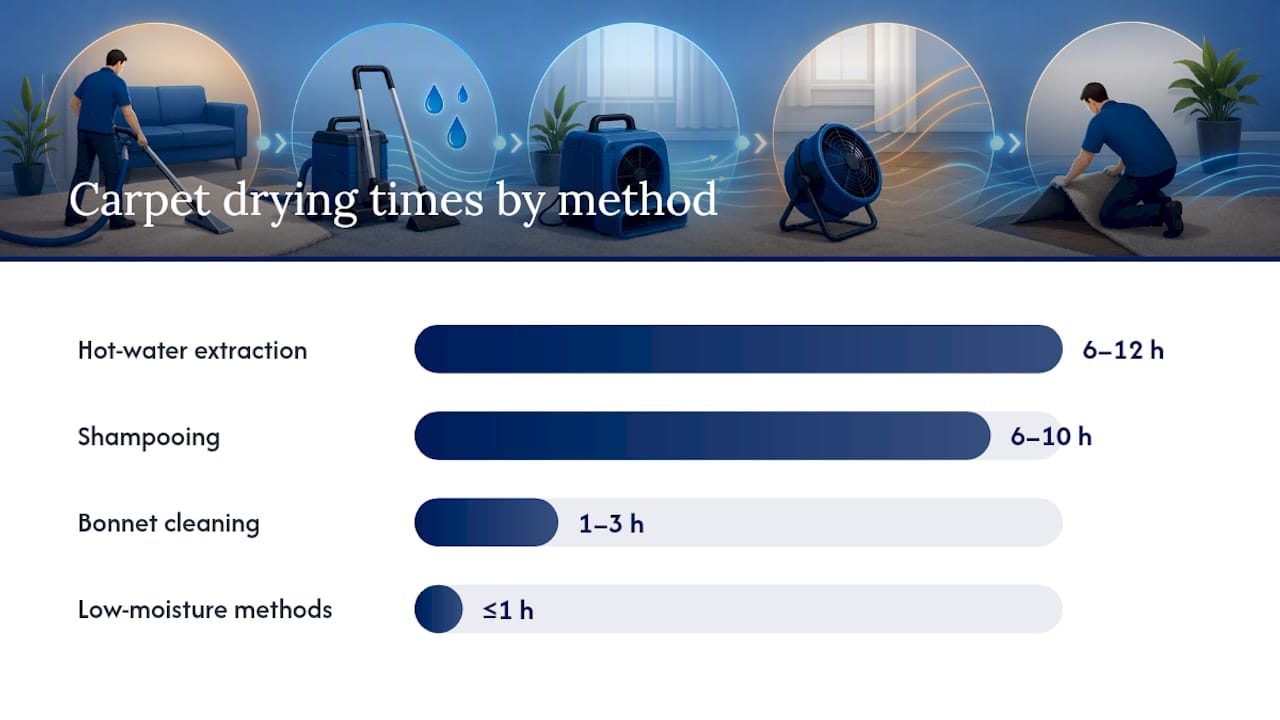
Encapsulation and dry compound cleaning work almost the opposite way. These low-moisture methods use minimal liquid or dry powder, so drying often finishes in under an hour, occasionally stretching to a few hours on thicker piles.
Other methods sit between these two extremes:
- Bonnet cleaning: light surface pass, dry within 1 to 3 hours, but only lifts surface soil.
- Carpet shampooing: heavier moisture load similar to extraction, expect 6 to 10 hours.
- Dry-compound cleaning: dry within an hour, safe to walk on almost immediately, though vacuuming residue is needed afterwards.
Treat every figure above as a range, not a promise. A room with poor ventilation or thick underlay will sit at the slow end regardless of which method your cleaner chose.
Five factors that determine how quickly a carpet dries
Two identical carpets cleaned the same way can dry hours apart. Here’s what actually decides the outcome:
- Airflow and ventilation. Fans angled low and across the carpet surface disturb the boundary layer of moist air sitting in the fibres. Point one straight down and you just push damp air into the pile instead of pulling it out.
- Carpet fibre, pile height and padding. Wool holds more moisture than synthetic fibres and releases it slower. Thick underlay acts like a sponge, and carpet thickness is one of the main variables manufacturers point to when estimating drying time.
- Equipment and technique. Truck-mounted extraction pulls out more water at the point of cleaning than portable units, meaning less is left for you to dry afterwards.
- Room features. Basements, rooms with external walls, and small enclosed spaces trap humidity and reliably add several hours to the total drying time.
Pro Tip: If you’ve got a choice, book carpet cleaning for a low-humidity day. Checking tomorrow’s forecast takes thirty seconds and can save you half a day of waiting.
How to speed up carpet drying: a step-by-step checklist
Once the cleaner has finished, you’ve got a short window where your actions matter more than anything else. Work through this in order:
- Turn on your HVAC system and set the fan to circulate, even if the heating or cooling isn’t needed. Constant air movement matters more than temperature.
- Position two fans or air movers at low angles across the carpet, not pointing straight down, and open doors between rooms to create cross-flow. Two air movers can cut drying time by roughly 50 to 65 percent, which is the single biggest change you can make yourself.
- Run a dehumidifier if the room feels humid, placed centrally. This adds another 20 percent reduction on top of fan use, and don’t forget to empty or drain the reservoir partway through.
- Hold off on furniture. Light items can go back once the surface feels dry, but heavy pieces, sofas, bed frames, wardrobes, should wait a full 24 hours. If you must move something back sooner, slide furniture coasters or foil squares under the legs so damp fibres aren’t crushed and marked.
- Monitor as you go. Press a clean towel onto the pile; if it stays dry, you’re on track. A moisture meter gives you a numeric check if you want more certainty. Persistent dampness after your first 24 hours means giving it another day, or calling in help.
Avoid two common mistakes: don’t spray more water onto a damp carpet trying to “freshen” it, and don’t rely on heat alone with the windows shut on a humid day. Heat without airflow just raises the moisture ceiling in the room rather than removing it.
When a damp carpet becomes a problem
A carpet that’s still wet after a day or two isn’t just inconvenient, it’s a genuine risk. Industry guidance treats residual moisture beyond 24 to 48 hours as an elevated risk window for microbial growth, so this is the point to start paying close attention rather than waiting it out.
Watch for:
- A musty, damp smell that doesn’t fade as the day goes on.
- Visible discolouration or dark patches, particularly along seams or near walls.
- Padding that feels squelchy or spongy underfoot, even if the surface seems dry.
- A room that still feels noticeably humid compared to the rest of the house.
If any of those show up, it’s time to call a professional rather than keep running fans and hoping. A proper remediation job typically involves taking moisture readings across the affected area, lifting sections of carpet to check the pad underneath, and running structural drying equipment if water has soaked through to the subfloor. In serious cases, the underlay gets replaced entirely and the area is sanitised before the carpet goes back down.
How to test whether your carpet is actually dry
Don’t guess, test. The simplest method is the towel test: press a clean white towel firmly onto the carpet for about ten seconds, then check it. If the towel comes away dry, the surface is dry; if there’s any dampness or discolouration transferred, give it more time. Repeat this in two or three spots, especially in corners and under furniture, since drying rarely happens evenly across a whole room.
A moisture meter gives you a more precise reading, but treat the number as a guide rather than gospel; different carpet types and pads register slightly differently.
- Hold off vacuuming until the carpet is fully dry, not just surface dry, or you risk pulling fibres out of shape.
- Keep pets and bare feet off damp carpet where possible, both to avoid tracking and because damp fibres mark more easily.
- Watch for wicking, brown staining that seems to reappear a day or two after cleaning as moisture travels up from the backing. Blot the spot with a cloth dampened in distilled water, then blot dry; if the mark persists, it needs a proper re-clean rather than more blotting.
Pro Tip: Keep a small stack of white towels by the door on cleaning day. You’ll test three or four spots before you even think about putting the sofa back.
What to expect from a professional carpet cleaner
A cleaner who knows their trade won’t leave you guessing about drying time. Swc-cleaning uses truck-mounted extraction alongside air movers and dehumidifiers on the job itself, aiming for that standard 6 to 12 hour surface-dry window rather than leaving carpets soaked and hoping the homeowner sorts out the rest.
Before you book anyone, three things should be given to you in writing, not just mentioned in passing:
- An estimated drying time based on the method being used and your room’s conditions.
- Drying precautions, meaning clear guidance on furniture, foot traffic, and ventilation for the following 24 hours.
- A follow-up plan if drying runs longer than quoted, so you’re not left wondering whether something’s gone wrong.
Swc-cleaning backs its carpet cleaning with eco-friendly products and a service guarantee, which matters if you’ve got pets, children, or allergy concerns in the house.
Why the standard advice on drying time misses the point
Most guides treat drying time as something that just happens to you, a fixed number you wait out. That’s backwards. The gap between a carpet that’s dry in 8 hours and one still damp at 30 hours almost never comes down to the cleaning method. It comes down to whether anyone bothered to point a fan at it.
Homeowners fixate on which cleaning method dries fastest, when the honest answer is that airflow discipline in the first few hours matters more than the method itself. A hot water extraction job with two fans and open doors will often beat a “quick-dry” encapsulation clean in a stuffy, sealed room. That’s not intuitive, but it’s what the numbers on air movers versus heat-only approaches actually show.
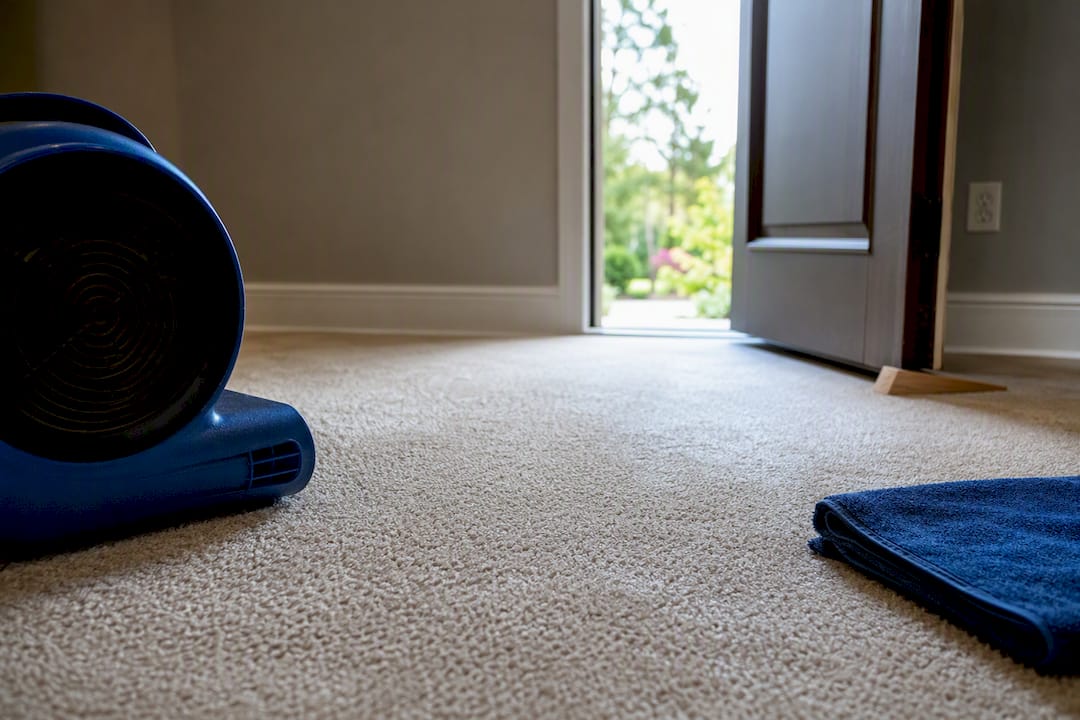
What I’d prioritise: don’t obsess over drying time before you book. Obsess over what happens in the four hours after the cleaner leaves. That’s the part you actually control, and it’s the part most people ignore.
Ready to book a professional clean with clear drying guidance built in? Explore SWC Cleaning’s carpet cleaning services and get a drying window in writing before the job starts.
— Scott